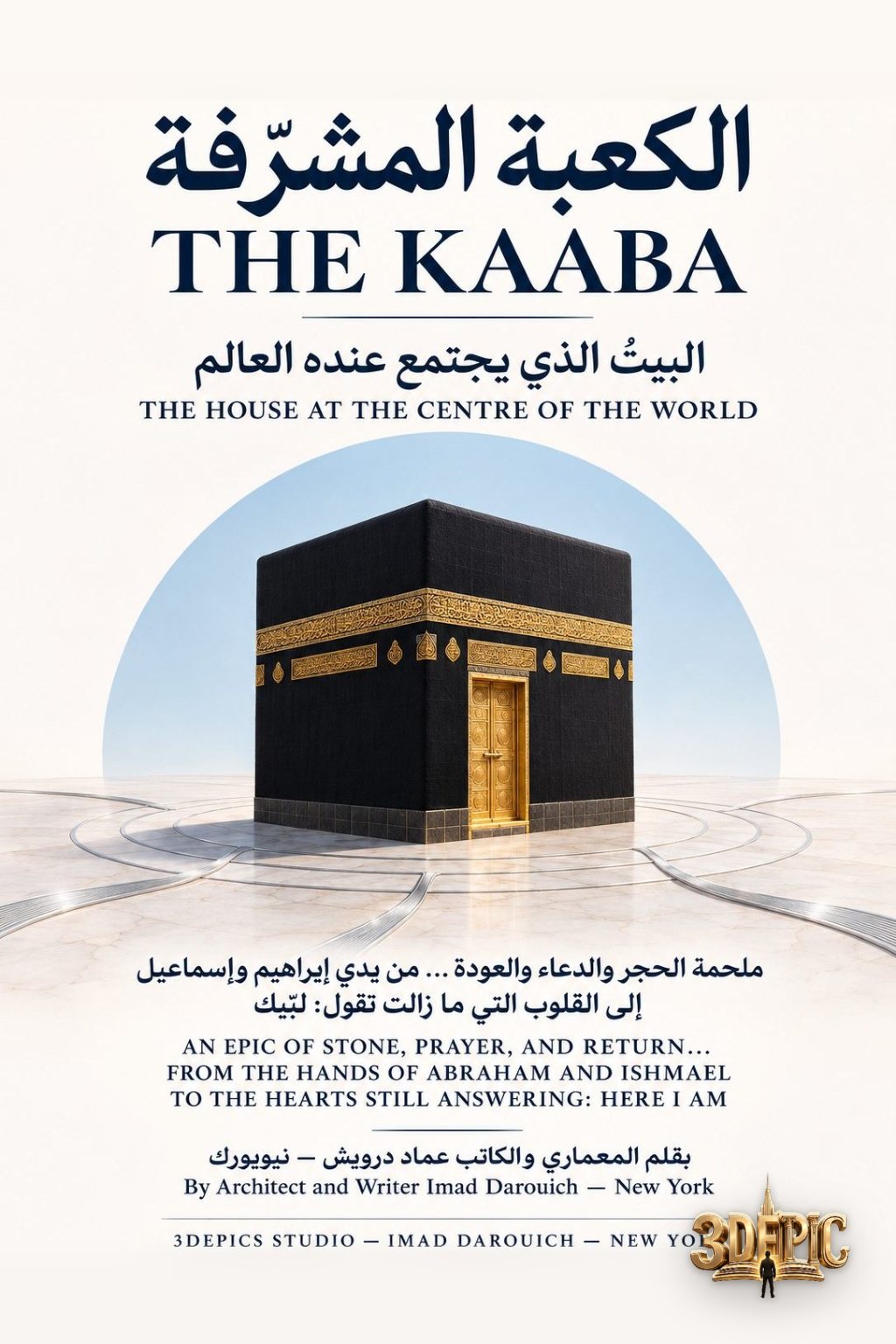
An architect who learned the qibla from an arrow his father drew in the Ghouta of Damascus walks Masjid al-Haram beside Yusuf and his mother Amina, through tawaf, the seam of the kiswa, sa'i in the memory of Hajar, Zamzam and the rows of the dawn prayer. The book asks what it means for every home to turn toward a single House.
The Kaaba and Masjid al-Haram: The Epic of the House Toward Which All Homes Turn is a bilingual ebook in English and Arabic about the Kaaba and the Sacred Mosque in Makkah, seen by an architect narrator who first learned the qibla from an arrow his father drew on a sheet of paper in the Ghouta of Damascus. It follows him from a childhood prostration in Jesreen to the dawn prayer in Makkah.
In Makkah he walks with Yusuf and his mother Amina, who have waited years for the journey, watches workers lift and reset an uneven paving stone so her step will land steadily, and first sees the Kaaba through the movement of the people around it. During tawaf Yusuf keeps his shoulder beside his mother's and the circle makes room for strangers, and afterwards the narrator notices a seam in the kiswa that reminds him of a woman mending a dress in the Ghouta.
In sa'i between Safa and Marwah the book remembers Hajar searching for water for her son Ishmael, peace be upon him, and Yusuf carries cups of Zamzam to his mother, waiting until she is seated. Before dawn people stand in rows beside strangers, and after the prayer the narrator unfolds his father's page and writes beside the arrow the words Makkah, after dawn, with his father's name.
For readers of Islamic sacred architecture and pilgrimage, and of memoirs about faith, family and the qibla.
That was the first time the room stretched, in my mind, all the way to Makkah.
Here, every circuit took its time from the steps of the people around us.