I. M. Pei's geometry as a system of thought, from the Louvre Pyramid and the Kennedy Library to the Bank of China Tower, the Suzhou Museum and the Museum of Islamic Art in Doha.
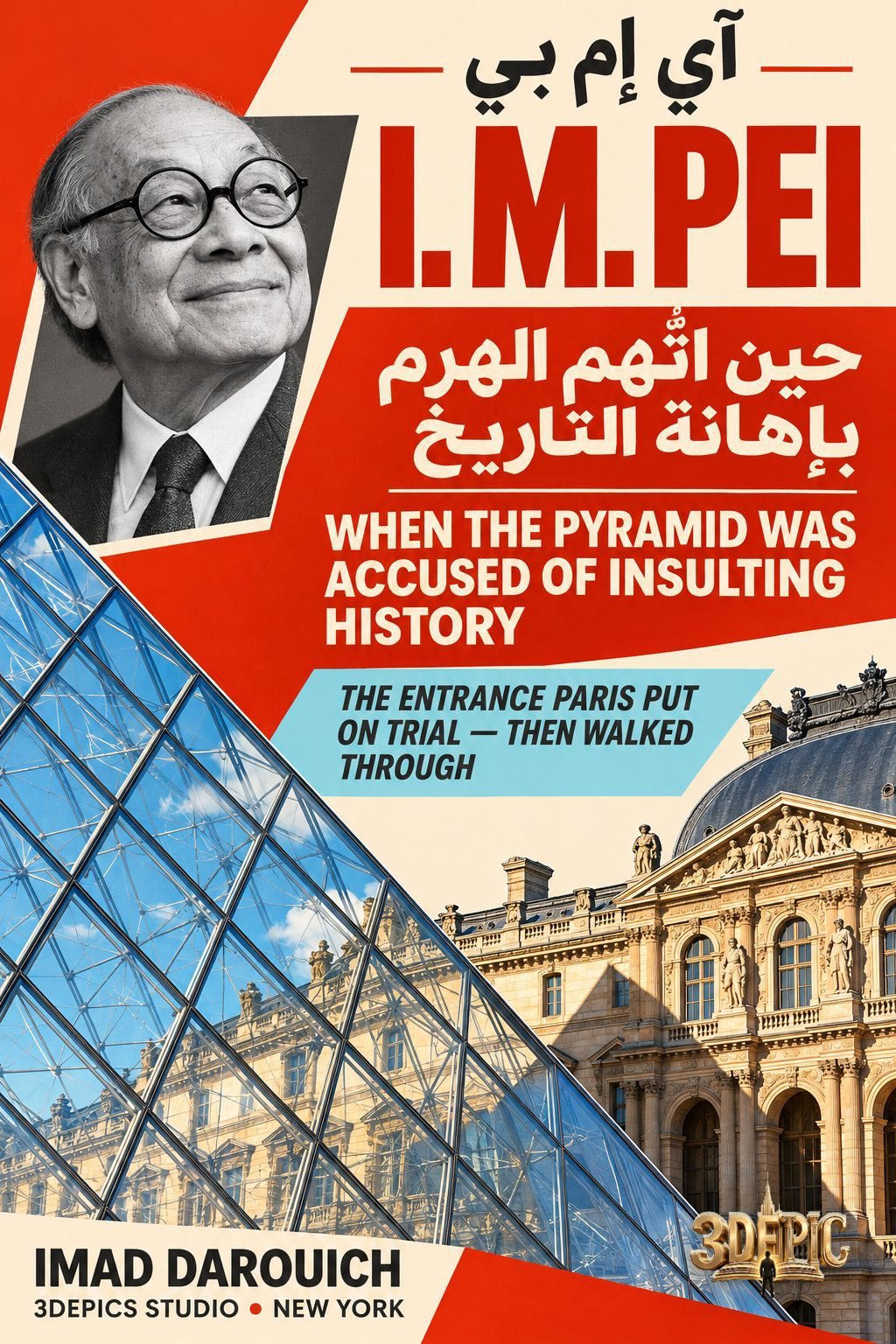
I. M. Pei: The Epic of Geometry and Light is a bilingual ebook in English and Arabic about the Chinese American architect for whom geometry was a system of thought rather than a shape. An architect narrator looks past the triangles, squares and circles of his work to the memory and light they hold.
The chapters follow him from China to America in search of a language, then the Louvre, where the pyramid faced history, the John F. Kennedy Library and national memory, the Bank of China Tower in Hong Kong, where geometry became structural power, and the Fragrant Hill Hotel, his return to China.
Later chapters visit the Suzhou Museum, where the man returned to the memory of place, and the Museum of Islamic Art in Doha, where he searched for the essence of a civilisation, then turn to light as the material that cannot be bought and to the Pritzker Prize. It is for readers of modernism, museums and Chinese and Islamic architecture.
When I look at I. M. Pei’s work, I do not see only triangles, squares, and circles.
And that an architect does not draw only for himself.