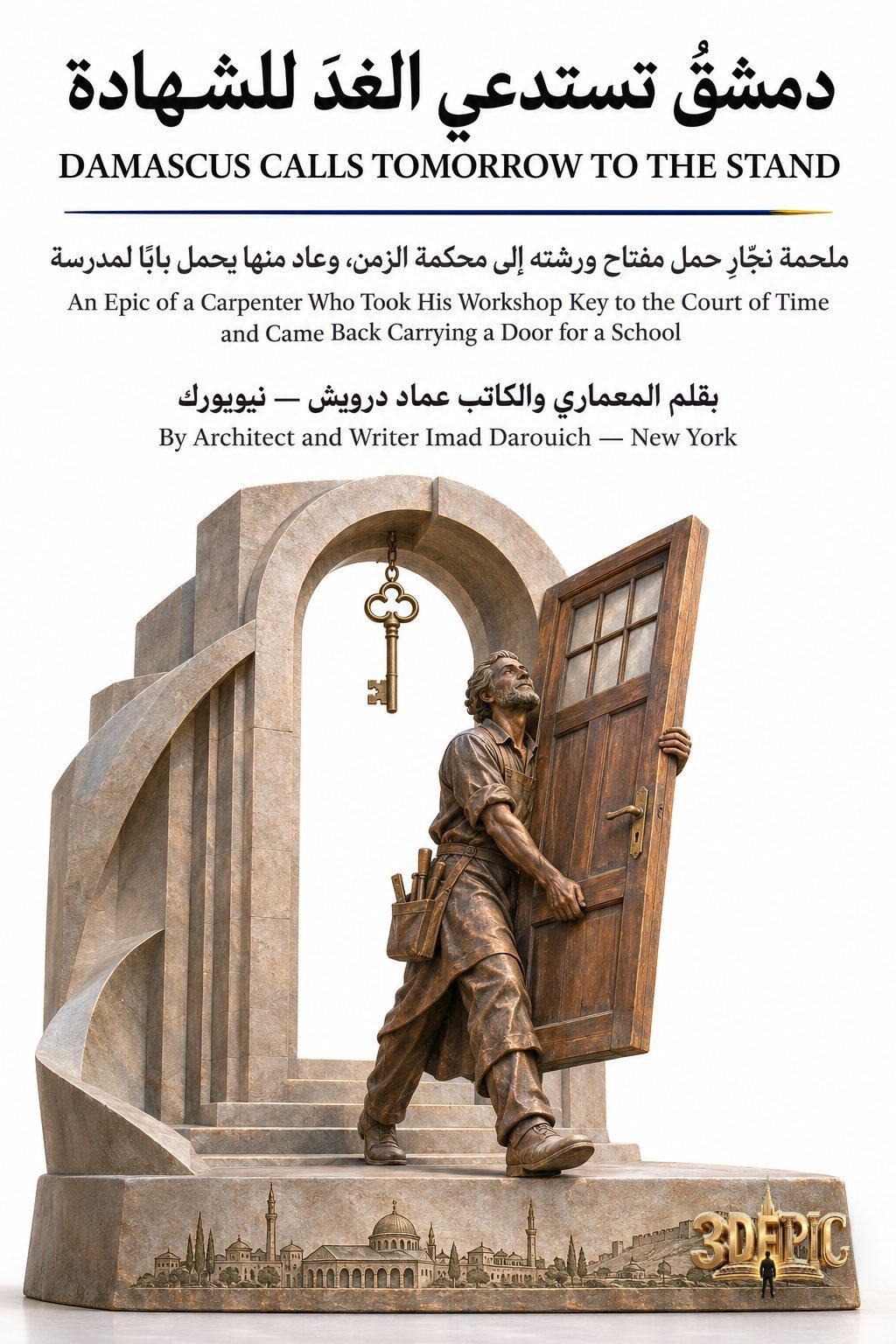
Architectural Epics is a bilingual ebook in English and Arabic that opens a series of the same name, carrying the history of architecture from Imhotep's stone at Saqqara to a public house for a neighbourhood in New York. It opens with a poem that walks through the ages of building; then an architect narrator lays out his plan for the house, with a reading room, a workroom and a courtyard, and a neighbour named Amina sets on it a photograph of her father resting by an open door and asks where people will find a place like that in the new building.
Each chapter sets a master beside a change in the plan. At Djoser's Step Pyramid the narrator thinks of the hands beneath the stone, and a mason turns a block so its smooth face meets those who sit; after the Parthenon and Vitruvius's firmness, utility and beauty, a boy in a wheelchair has the window sill lowered so he can see his friend coming up the street. Saint-Denis, Brunelleschi's dome, Palladio, Frank Lloyd Wright's Fallingwater, the Bauhaus with Mies van der Rohe and Le Corbusier, and Brutalism and Postmodernism each meet a neighbour's correction: the late afternoon sun on a reading table, a door that swings across a route, rain that needs room in the courtyard, an armrest put back on a bench, a blue arch a girl draws over the entrance.
With Zaha Hadid, Norman Foster and Tadao Ando the narrator reworks movement, air and light, and with Hassan Fathy and Rasem Badran he returns to earth that neighbours know how to mend and to the memory of the Arab lane. Before the plan is approved the neighbours chalk the walls on the empty lot at full size and Amina widens the space by the door; years later the narrator sits on the bench outside the finished building with the photograph of her father and listens to the voices inside.
For readers of architectural history and of design that begins with the people who will use a building, from students of architecture to anyone who has waited at a door.